
The range of workshops, lunchtime debates and keynote speeches at LikeMinds had a great deal to offer, and I’ll be sorting the wheat from the chaff for some time to come.
Yet sifting through the cornucopia of ideas, the discussions on #SM, publishing, content, data, curation and creation, I keep coming back to Don Boyd’s amazing talk on How to Make Great Films in a YouTube Age.
Mr Boyd described his “experiment in theatre and cinema” conducted at the Traverse Theatre, Edinburgh. With Dominic Hill, artistic director at the Traverse, he brought together a creative team of writers, actors, directors and technicians to make Impossible Things Before Breakfast, staged play readings that would be simulcast in HD to cinemas.
Live transmission
The project included a filmed set of rehearsals that were later vision-mixed in real-time and transmitted to 31 cinemas around the country. Five theatre directors worked with invited performers who read new plays which were simultaneously filmed. A heady brew!
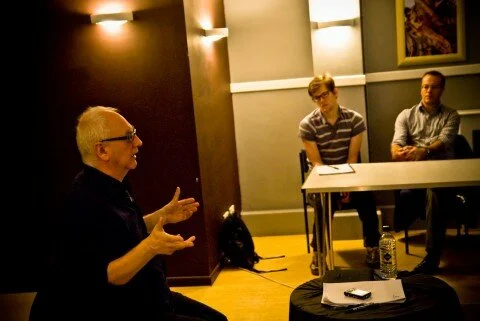
The experiment is described by the man himself in the LikeMinds magazine, so here I only reflect my impressions of Mr Boyd’s talk, which took place in a featureless basement room in the Exeter exhibition Centre.
Cine-industrial complex
For an hour this was essentially a monologue. A fascinating, erudite, enthralling monologue. Mr Boyd (b. 1948) trained in the film-maker’s modus operandi of the time, an industrialised process that used mechanical cameras. It was a system, a sophisticated procedure, with lots of teams of people doing set jobs.
That systematic approach is a million miles away from today where we can shoot, edit and publish our own ‘movies’ in minutes.
A lot of successful producer/directors might ‘take their foot off the gas’, and bask in a successful career within such a system. Not Mr Boyd, who embraces new technologies and their possible futures.
He is candid as to why the new rules of making movies suit him better:
“I am free from a system where people I have to work with want to change what I do.”
The dark side of the Hollywood system of old is that it controlled a conduit of culture into peoples’ minds. Producers controlled the flow of information… and as a result, the audience was coerced into a way of thinking.
“Today we can operate and create without the tyranny of that editorial process.”
When eventually the switch was flicked and the Impossible Thing(s) went live, vision-mixer (Richard Scollard) and directors worked in creative tandem to provide an element of authorship to the cinema transmission. So:
- a live audience watched the play
- and a different audience watched the movie.
Interestingly, none of the actors, directors or anyone in the theatre ever saw the live transmissions in a cinema. That cinema audience saw something truly unique.
Stuck in the moment with you
Cinema audiences said that they were somehow ‘in the moment’, even if the whole thing was chaotic. People were engaged by the text. The closest cinematic comparison suggested was Lars Von Trier’s Dogville - where actors moved around a bare stage with the position of furniture and doorways was blocked and drawn.
Mr Boyd’s gripping tale about creation and curation really made me think about my own work, and how the best executions are almost always the result of collaboration under pressure.
Sticking with LikeMinds, you also like to read how Instagram has made us all top photographers.